Sudden and Dramatic Escalation
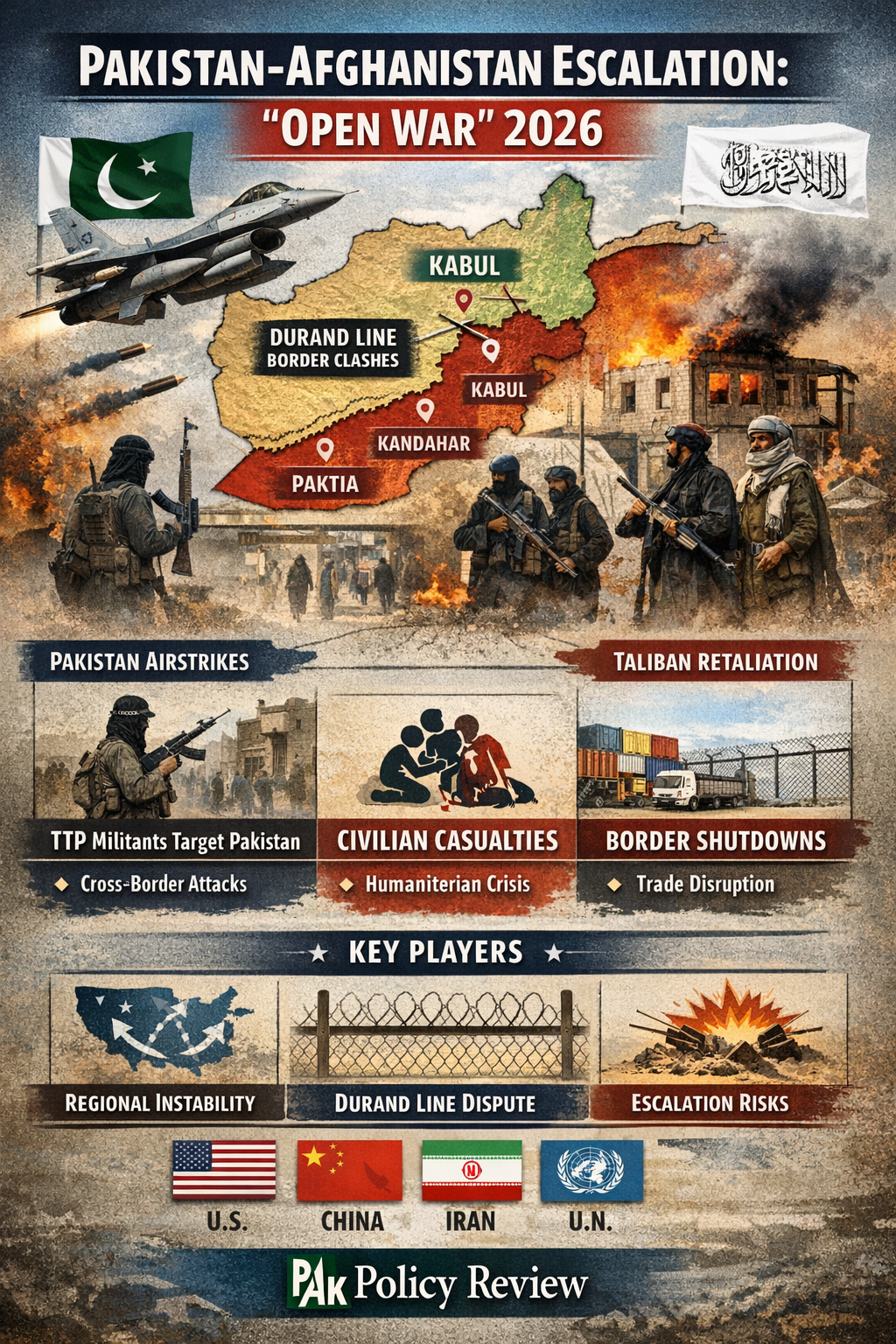
In a dramatic turn of events on 27 February 2026, Pakistan’s defence minister publicly declared the country to be in a state of “open war” with Afghanistan after intense cross-border attacks and retaliatory strikes between Islamabad and the Kabul government led by the Taliban. Pakistan conducted air and ground strikes on multiple Afghan locations — including the capital Kabul and provinces such as Kandahar and Paktia — marking an escalation not seen in years between the two neighbours.
Afghan authorities responded with their own offensive operations against Pakistani forces along the disputed border, claiming to have inflicted significant losses. Both sides have released conflicting casualty figures that remain independently unverified
Claims and Counterclaims
- Pakistan’s Position: Islamabad argues its strikes targeted Taliban leadership, militant bases, and command posts responsible for harbouring groups like the Tehreek-e-Taliban Pakistan (TTP) and other affiliates blamed for a spate of deadly attacks inside Pakistan. Pakistan claims it conducted “intelligence-based selective operations” aimed at degrading militant capabilities.
- Taliban’s Response: Kabul strongly condemned the incursions as violations of sovereignty and reported retaliatory strikes deep inside Pakistani territory. The Afghan government also counter-accused Islamabad of aggressive actions that harmed civilians and military personnel.
Both governments have circulated widely divergent casualty figures and battlefield outcomes, underscoring how opaque and contested the situation remains.
Roots of the Escalation
Long-standing Border Tensions
At the heart of the conflict is the 2,600-kilometre Durand Line, a frontier that Afghanistan has historically refused to formally recognize. The disputed border has been a flashpoint for repeated skirmishes well before the current crisis, which has been intensifying since the Taliban’s return to power in 2021.
Militant Violence and Cross-Border Militia
Pakistan has repeatedly accused Afghanistan of providing sanctuary to militants, particularly the TTP — which Islamabad blames for numerous suicide bombings and insurgent attacks in major Pakistani cities and border regions. Kabul denies any state support for armed groups operating against Pakistan and insists it has neither the capacity nor intent to export terrorism.
Cross-border militant violence has surged in recent months, including suicide bombings and coordinated attacks attributed to TTP and Islamic State-Khorasan (ISKP) factions, compounding Islamabad’s security concerns.
Failed Diplomacy and Ceasefire Breakdown
In late 2025, mediation efforts by Qatar and Türkiye resulted in a temporary ceasefire and attempted negotiations between the two states, but those efforts failed to produce sustainable peace. With the ceasefire lapsing and trust deteriorating, recent incidents escalated into outright military confrontation.
Regional and International Response
Outside Support and Diplomatic Messaging
- United States: Washington has publicly supported Pakistan’s right to self-defence while criticizing Afghanistan’s alleged failure to curb militant operations. U.S. officials have also expressed concern about the rising conflict and its humanitarian impact.
- United Nations: Calls for immediate de-escalation and protection of civilians have been issued by the U.N. and international humanitarian bodies.
- Regional Actors: Middle Eastern nations and other neighbours have urged both governments to exercise restraint and return to the negotiating table.
Strategic Implications
Analysts warn that this conflict could destabilize an already fragile region, potentially spilling over into broader geopolitical rivalries involving India, Iran, and global powers with strategic interests in South Asia.
Humanitarian and Civilian Impact
Despite contrasting official narratives, independent reports suggest significant civilian harm, especially in Afghan border provinces where Pakistani airstrikes hit populated areas. Casualty figures are disputed but point to a humanitarian crisis unfolding alongside the military confrontation.
Border closures and halted trade have also deepened economic hardship in both countries, disrupted commerce, and created obstacles for refugees and traders along key transit routes.
Policy Analysis and Outlook
Security vs Diplomacy
The escalation underscores a core policy dilemma for Islamabad: balancing aggressive counter-terrorism operations with the risk of broad interstate war and regional isolation. For Kabul, the conflict undermines its assertions of legitimacy and control over armed elements along the frontier.
Durand Line and Sovereignty
The unresolved dispute over the Durand Line remains a fundamental challenge. Without a mutually accepted border mechanism and credible security guarantees, periodic flare-ups are likely to recur.
Need for Mediation
Given the mutual mistrust and grave stakes, renewed external mediation — potentially involving regional heavyweights and neutral parties — may be crucial to de-escalate tensions and establish a framework for long-term conflict management.
Conclusion: What began as a series of cross-border attacks has escalated into what Pakistan’s leadership calls an “open war” with neighboring Afghanistan — a dangerous turning point with broad geopolitical, humanitarian, and security consequences for South Asia.