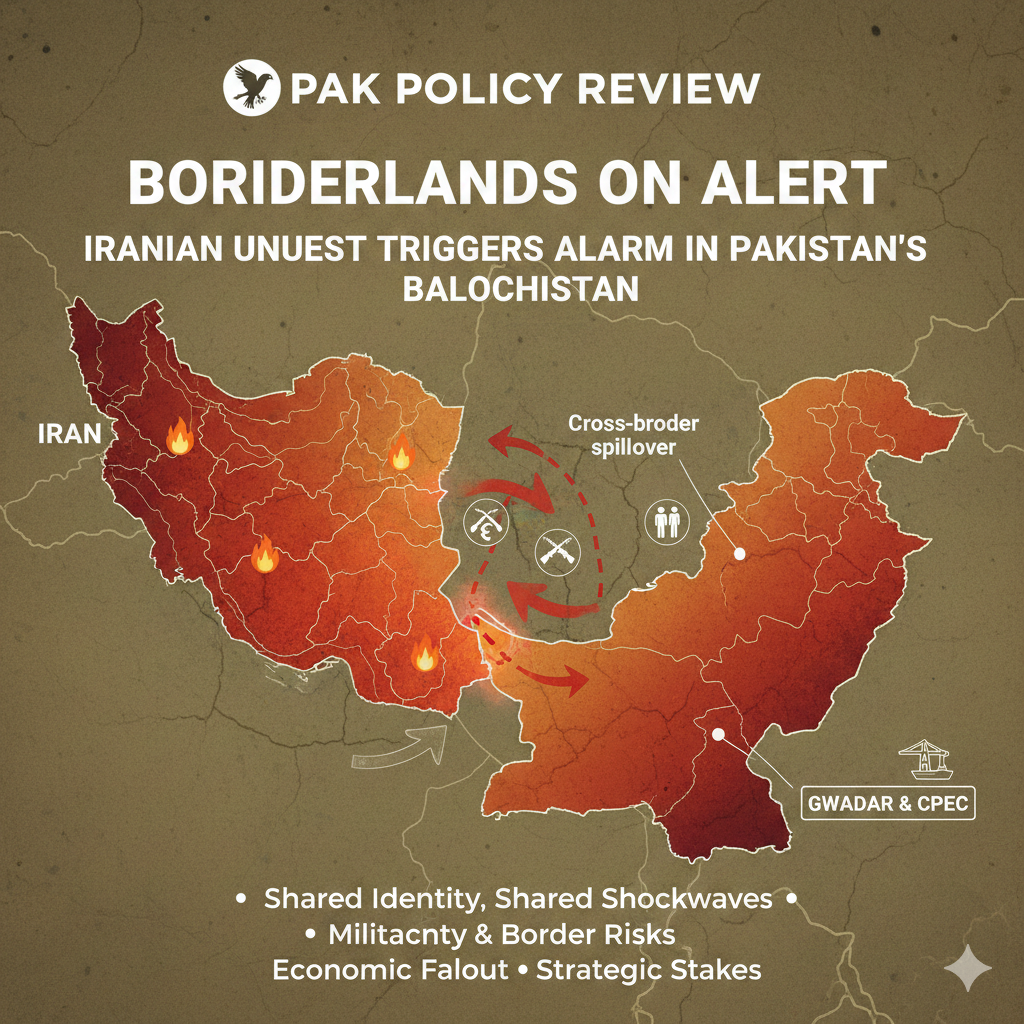
Islamabad/Quetta — The latest wave of unrest in Iran, particularly in the southeastern province of Sistan-e Baluchestan, is triggering growing security and political concerns in Pakistan’s Balochistan, as authorities fear cross-border spillover, militant regrouping, and economic disruption along the sensitive Iran-Pakistan frontier.
Iran has intensified security operations in its Baloch-majority regions following protests driven by economic hardship, political exclusion, and long-standing ethnic grievances. Pakistani officials and security analysts say the situation has direct implications for border stability, especially given the shared ethnic, religious, and economic ties between Baloch communities on both sides.
Shared Identity, Shared Shockwaves
The Baloch population spans Iran and Pakistan, making unrest in one country difficult to contain geographically. While protests elsewhere in Iran have focused on inflation and governance, demonstrations in Sistan-e Baluchestan have increasingly reflected ethnic and sectarian grievances, particularly among the Sunni Baloch minority.
Analysts note that unrest in Iranian cities such as Zahedan often resonates across the border, reinforcing narratives of marginalization among Baloch communities in Pakistan’s southwest. This dynamic, experts warn, can energize political activism and separatist sentiment in Pakistani Balochistan.
Militancy and Border Risks
Security officials say internal instability in Iran may create operational space for militant groups, including Sunni Baloch outfits that have previously targeted Iranian security forces. Any intensified crackdown by Tehran risks pushing militants toward Pakistani territory, complicating Islamabad’s counter-insurgency efforts.
The concern is heightened by recent history. In early 2024, retaliatory strikes exchanged by Iran and Pakistan—triggered by militant attacks—demonstrated how localized insurgent violence can quickly escalate into state-level confrontation.
“With tensions already high, the border has become increasingly sensitive,” a senior security analyst told Pak Policy Review, warning that miscalculation could lead to renewed diplomatic or military escalation.
Economic Fallout Along the Border
Beyond security, the unrest is disrupting the informal cross-border economy that sustains thousands of families in Balochistan. Periodic border closures have halted the flow of Iranian fuel and consumer goods, leading to shortages and price hikes in several districts.
Local traders say prolonged instability could deepen economic grievances, while humanitarian groups warn that intensified repression in Iran may trigger population displacement toward Pakistan, adding pressure to already under-resourced border areas.
Strategic Stakes: Gwadar and CPEC
The unrest also intersects with broader geopolitical concerns. Balochistan is central to the China-Pakistan Economic Corridor (CPEC) and the strategic Gwadar Port, both of which have been targeted in the past by separatist groups.
Security experts caution that instability across the border could embolden militant factions that oppose foreign investment, viewing it as exploitation amid local deprivation. Any perception of weakened state control—either in Iran or Pakistan—could further complicate security around strategic infrastructure.
A Region on Edge
Analysts agree that Iran’s unrest is unlikely to remain an internal matter. For Pakistan, the challenge lies in preventing spillover while avoiding further militarization that could inflame local grievances in Balochistan.
“Without coordinated border management and a shift away from purely security-centric approaches, both states risk deepening instability,” analysts warn.
As protests continue in Iran, Pakistan’s western border remains on alert—highlighting how internal crises in one country can rapidly become regional security challenges in an interconnected and fragile borderland.