CCI Recommendations
Focus Keywords:
Council of Common Interests population policy, Pakistan family planning policy, CCI recommendations population, Pakistan population growth rate, contraceptive prevalence rate Pakistan, family planning reforms Pakistan
Pakistan’s population debate reached a turning point in 2018 when the Council of Common Interests (CCI) approved a new, rights-based approach to family planning. Instead of framing the issue as “population control,” the state began recognising family planning as a public health, development, and human rights concern.
This shift was triggered by a suo motu notice taken by the Supreme Court of Pakistan on the country’s alarming population growth rate. At the time, Pakistan was growing at nearly 2.4 percent annually, one of the highest rates in South Asia. In response, a Federal Task Force on Population was formed, whose recommendations were approved during the 39th and 40th CCI meetings in late 2018.
🔗 Supreme Court of Pakistan (Suo Motu Jurisdiction):
https://www.supremecourt.gov.pk
🔗 Council of Common Interests – Government of Pakistan:
https://cabinet.gov.pk/cci
The 8 Key CCI Recommendations on Population (2018)
The CCI’s population framework rests on eight strategic pillars, aimed at slowing population growth and improving access to reproductive health services across Pakistan.
1. Strong Institutional Leadership
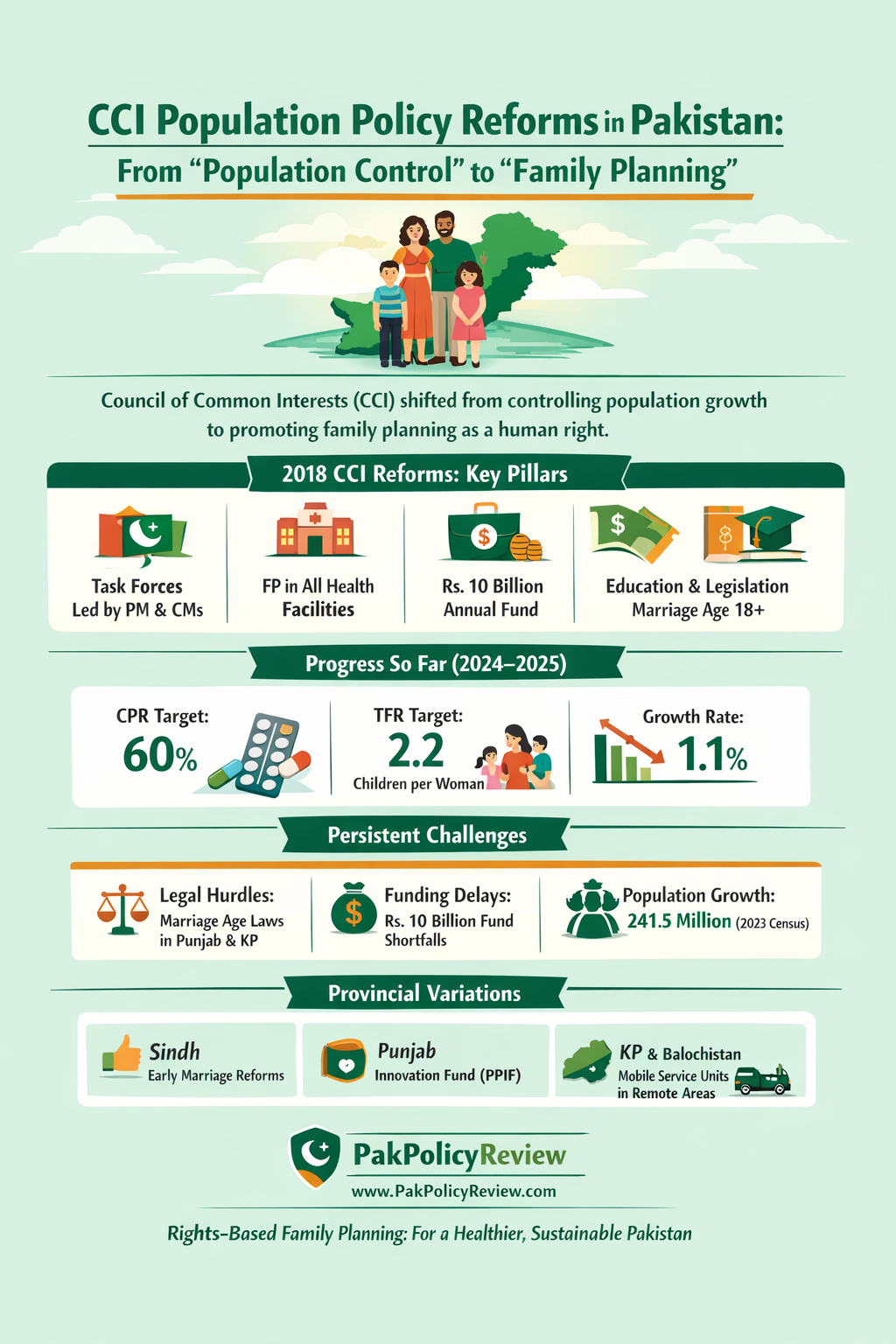
National and Provincial Population Task Forces were established, chaired by the Prime Minister and Chief Ministers, to ensure political ownership.
2. Universal Access to Family Planning
Family planning services were to be integrated into Basic Health Units (BHUs), Rural Health Centres (RHCs), and private hospitals.
3. Sustainable Financing
A five-year, non-lapsable special fund was proposed, with an annual allocation of Rs. 10 billion.
4. Legal and Legislative Reforms
The CCI recommended the Family Planning & Reproductive Health Rights Bill and standardising the minimum legal age of marriage at 18 years.
5. National Advocacy Campaign
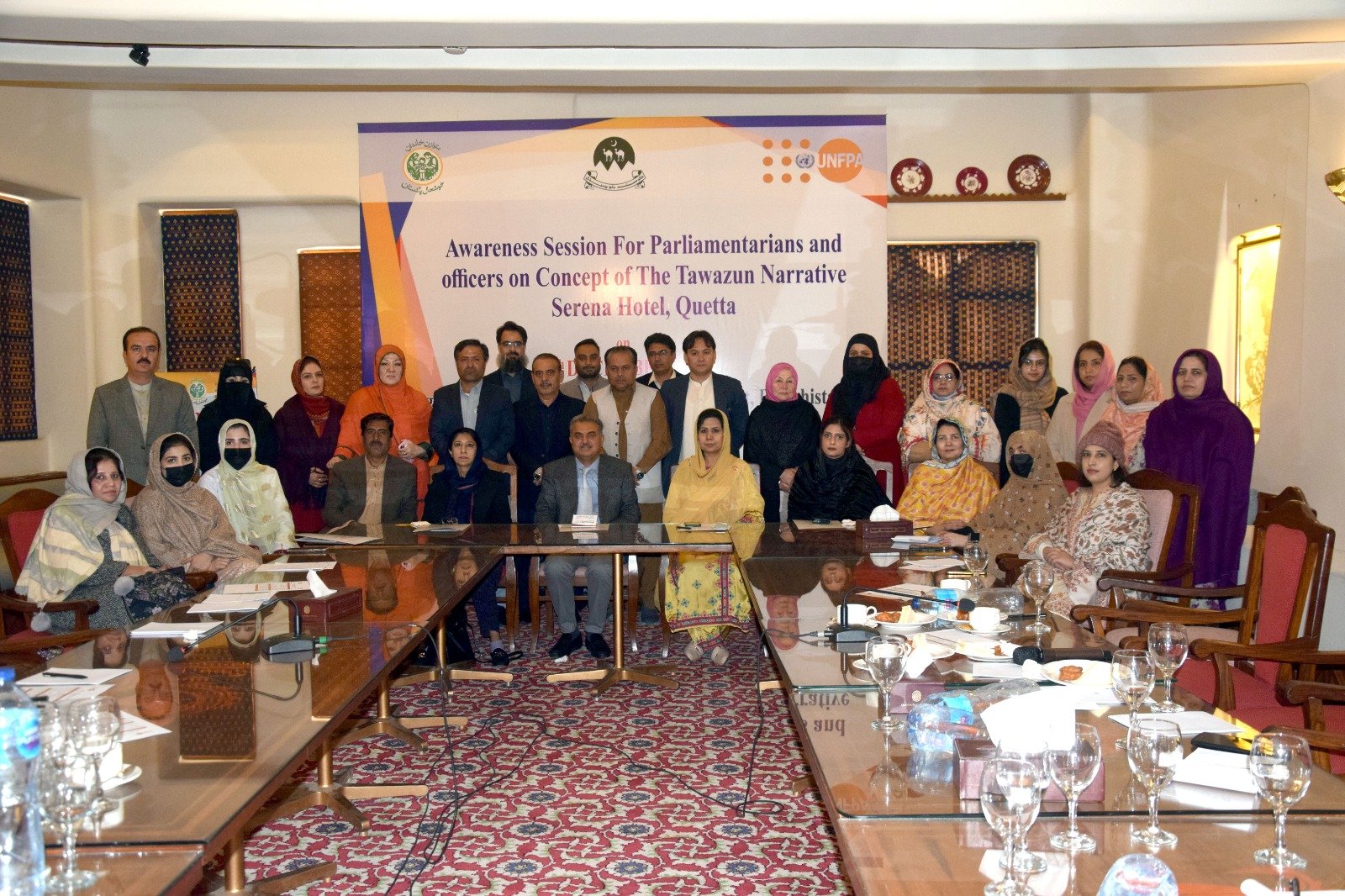
A unified national narrative, branded “Tawazun” (Balance), was launched. PEMRA-regulated TV channels were directed to provide free airtime.
6. Education and Curriculum Reform
Population and family planning themes were to be integrated into school and university curricula.
7. Reliable Contraceptive Supply
The federal government committed to procuring contraceptives centrally to prevent provincial supply gaps.
8. Engagement with Religious Scholars
Ulema were engaged to promote birth spacing through Islamic teachings, countering misconceptions about family planning.
🔗 UNFPA Pakistan – Family Planning:
https://pakistan.unfpa.org
Implementation Status (2024–2025): Progress and Gaps
More than six years on, implementation presents a mixed picture. Institutional frameworks exist, but on-ground results remain uneven.
Key Achievements So Far
National Action Plan (2025–2030)
The Ministry of National Health Services has revised the National Action Plan with ambitious targets:
- Contraceptive Prevalence Rate (CPR): 60% by 2030 (currently ~34–35%)
- Total Fertility Rate (TFR): 2.2 children per woman (currently ~3.6)
- Population Growth Rate: 1.1% (currently ~2.55%)
🔗 Ministry of National Health Services:
https://www.nhsrc.gov.pk
“Tawazun” Narrative
The national discourse now focuses on balancing family size with household resources, rather than coercive population control.
CCI Monitoring Portal
A real-time monitoring dashboard, developed with UNFPA, tracks provincial performance on key indicators.
Persistent Challenges and Policy Gaps
Legislative Stagnation
Sindh moved early by passing the Child Marriage Restraint Act, but Punjab and KP continue to face political and religious resistance to setting 18 as the minimum marriage age.
Funding Constraints
The proposed Rs. 10 billion annual fund has suffered delays due to Pakistan’s fiscal stress and IMF-mandated austerity measures.
2023 Digital Census Reality Check
The 2023 Census recorded Pakistan’s population at 241.5 million, with a growth rate of 2.55%, underscoring the gap between policy intent and field-level impact.
🔗 Pakistan Bureau of Statistics – Census 2023:
https://www.pbs.gov.pk
Provincial Variations in Population Policy Implementation
Sindh
Leads on legislative reform, particularly on early marriage and reproductive health rights.
Punjab
Introduced the Punjab Population Innovation Fund (PPIF) to pilot new service delivery models.
🔗 Punjab Population Innovation Fund:
https://ppif.punjab.gov.pk
Khyber Pakhtunkhwa & Balochistan
Why CCI Population Reforms Still Matter
Pakistan’s demographic future will shape its economy, education system, healthcare capacity, and climate resilience. The CCI framework remains the most comprehensive attempt to address population growth through rights, services, and informed choice—but its success depends on political continuity and sustained investment.