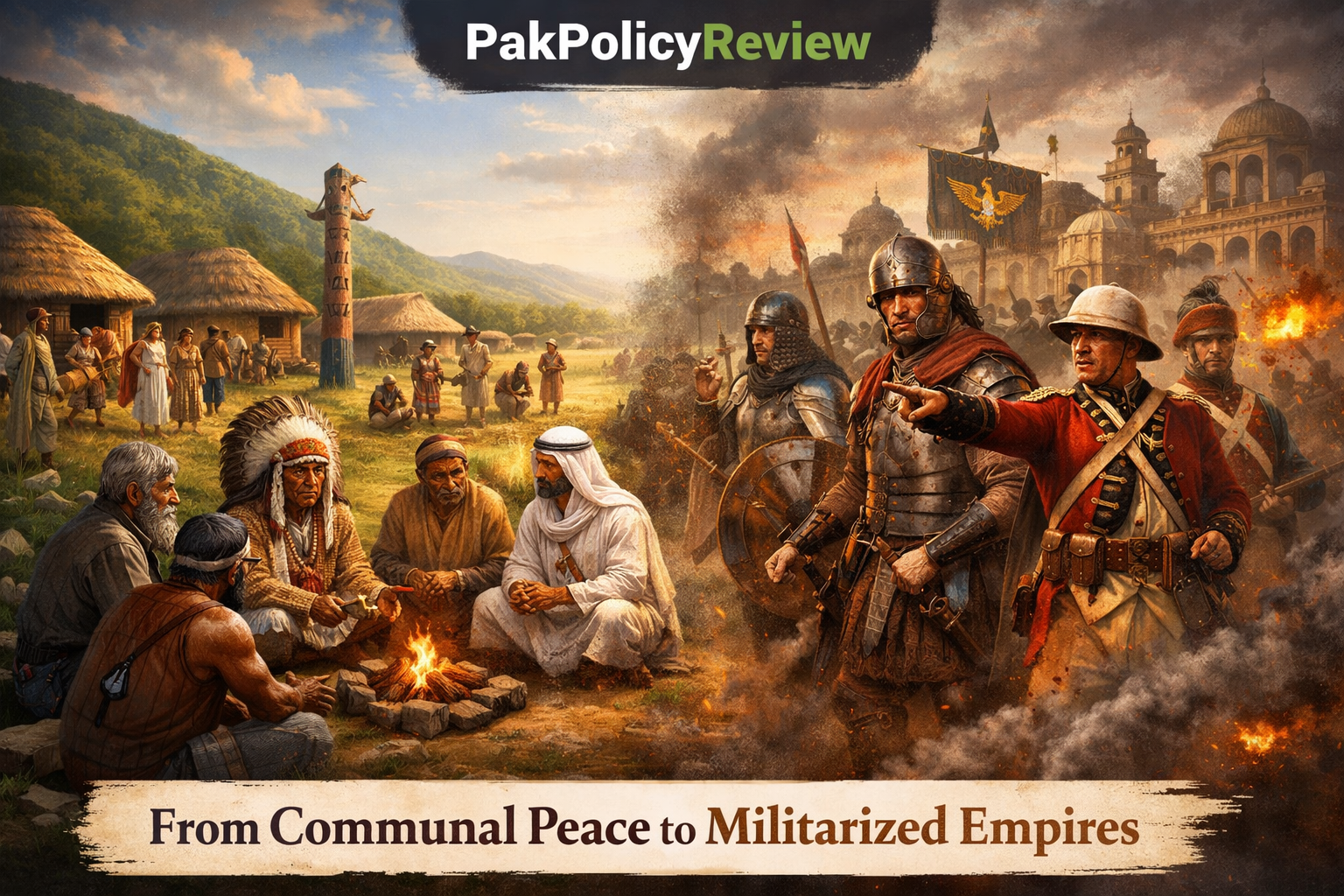
Throughout most of human history, communities—not professional armies—were the main providers of security. Peace was maintained through shared responsibility, kinship ties, and social norms. Security was a civic duty, not a function controlled by a centralized military institution.
In early societies, order depended on mutual respect and collective accountability. There were no permanent armies. Instead, communities resolved disputes internally and mobilized only when absolutely necessary. This model treated security as a shared obligation rather than a specialized profession.
In many tribal societies across Africa, Asia, and the Americas, standing armies simply did not exist. Among the Igbo of West Africa, age-grade systems and councils of elders managed security and justice. Protection was communal, and warfare was rare and temporary.
Similarly, the Iroquois Confederacy in North America maintained peace through the Great Law of Peace, a consensus-based political system established as early as the 12th century. Stability came from diplomacy and shared governance, not from a permanent warrior class.
(Read more on Indigenous governance models here: https://www.britannica.com/topic/Iroquois-Confederacy)
Early Germanic and Celtic societies followed the same pattern. Warriors were citizens, not professionals. Assemblies were formed only in times of threat. Among Bedouin Arab tribes, inter-tribal alliances (hilf) and honor-based codes regulated conflict and ensured cooperation. Social cohesion, not military force, preserved order for centuries.
This model changed with the rise of centralized empires. As states expanded, professional armies became tools of control. Empires such as the Roman, Persian, and Qin Chinese built standing militaries to collect taxes, suppress dissent, and conquer territory. These armies protected elite interests, not communal peace.
(See historical overview: https://www.britannica.com/topic/imperialism)
The trend intensified in the medieval and early-modern eras. Monarchs like Louis XIV of France relied on large professional armies funded by heavy taxation. These forces served royal power, not local communities.
The rise of corporate militaries made this even clearer. The British East India Company maintained a private army larger than many European states. It used military force to seize land, extract resources, and dismantle indigenous governance across South Asia.
Modern nation-states inherited this system. The First and Second World Wars showed how standing armies fuel arms races and mass destruction. During the Cold War, global security became dependent on military deterrence, creating permanent instability even without direct war.
History reveals a clear pattern: professional armies rarely produce lasting peace. More often, they enable domination, resource extraction, and political repression. In contrast, societies rooted in communal responsibility and social balance have shown greater success in maintaining harmony without institutionalized violence.
If global peace is to be sustainable, the world must rethink its dependence on military power. Re-centering security within communities—through cooperation, dignity, and mutual responsibility—offers a viable alternative. Reducing the central role of armies in political authority may be essential for building a more just and peaceful world.
References
- Diamond, J. (1997). Guns, Germs, and Steel: The Fates of Human Societies. W.W. Norton & Company.
— Explores how social organization and power structures evolved, including the role of violence and militarization. - Keegan, J. (1993). A History of Warfare. Vintage Books.
— Provides a critical examination of warfare, emphasizing that organized armies are not universal to human societies. - Service, E. R. (1975). Origins of the State and Civilization. W.W. Norton & Company.
— An anthropological study of pre-state societies and communal governance systems. - Britannica Editors. Iroquois Confederacy. Encyclopaedia Britannica.
https://www.britannica.com/topic/Iroquois-Confederacy
— Documents the Great Law of Peace and consensus-based governance. - Falola, T., & Heaton, M. (2008). A History of Nigeria. Cambridge University Press.
— Details Igbo political systems, age-grade institutions, and communal security mechanisms. - Clastres, P. (1989). Society Against the State. Zone Books.
— Argues that many indigenous societies actively resisted centralized power and standing armies. - Kennedy, P. (1987). The Rise and Fall of the Great Powers. Vintage Books.
— Explains how military expansion served imperial and elite interests rather than public welfare. - Mukherjee, R. (2010). The East India Company: The Corporate Origins of Empire. Harvard University Press.
— Examines the militarization of corporate power and colonial conquest in South Asia. - Bayly, C. A. (1988). Indian Society and the Making of the British Empire. Cambridge University Press.
— Explores how colonial armies dismantled indigenous governance systems. - Tilly, C. (1992). Coercion, Capital, and European States. Blackwell.
— Influential work linking state formation to organized violence and taxation. - Hobsbawm, E. (1994). The Age of Extremes: The Short Twentieth Century. Vintage Books.
— Analyzes the world wars, militarization, and the Cold War security order. - History Editors. Cold War History. History.com.
https://www.history.com/topics/cold-war/cold-war-history
— Overview of global militarization and deterrence politics. - Galtung, J. (1969). “Violence, Peace, and Peace Research.” Journal of Peace Research, Vol. 6(3).
— Foundational peace studies work distinguishing structural violence from communal peace.