The agricultural sector remains the backbone of Pakistan’s economy, contributing approximately 24% to the GDP and employing nearly 37% of the national workforce. Since its independence in 1947, Pakistan has navigated a complex path of policy shifts—from feudal-centric systems to the high-yield “Green Revolution,” and more recently, toward corporate farming and climate-resilient agritech.
1. Historical Evolution of Agricultural Reforms
Pakistan inherited a deeply unequal land-tenure system from the British Raj, characterized by absentee landlordism and a marginalized peasantry.1 To address this, three major waves of land reforms were attempted.
The 1959 Reforms (Ayub Khan Era)
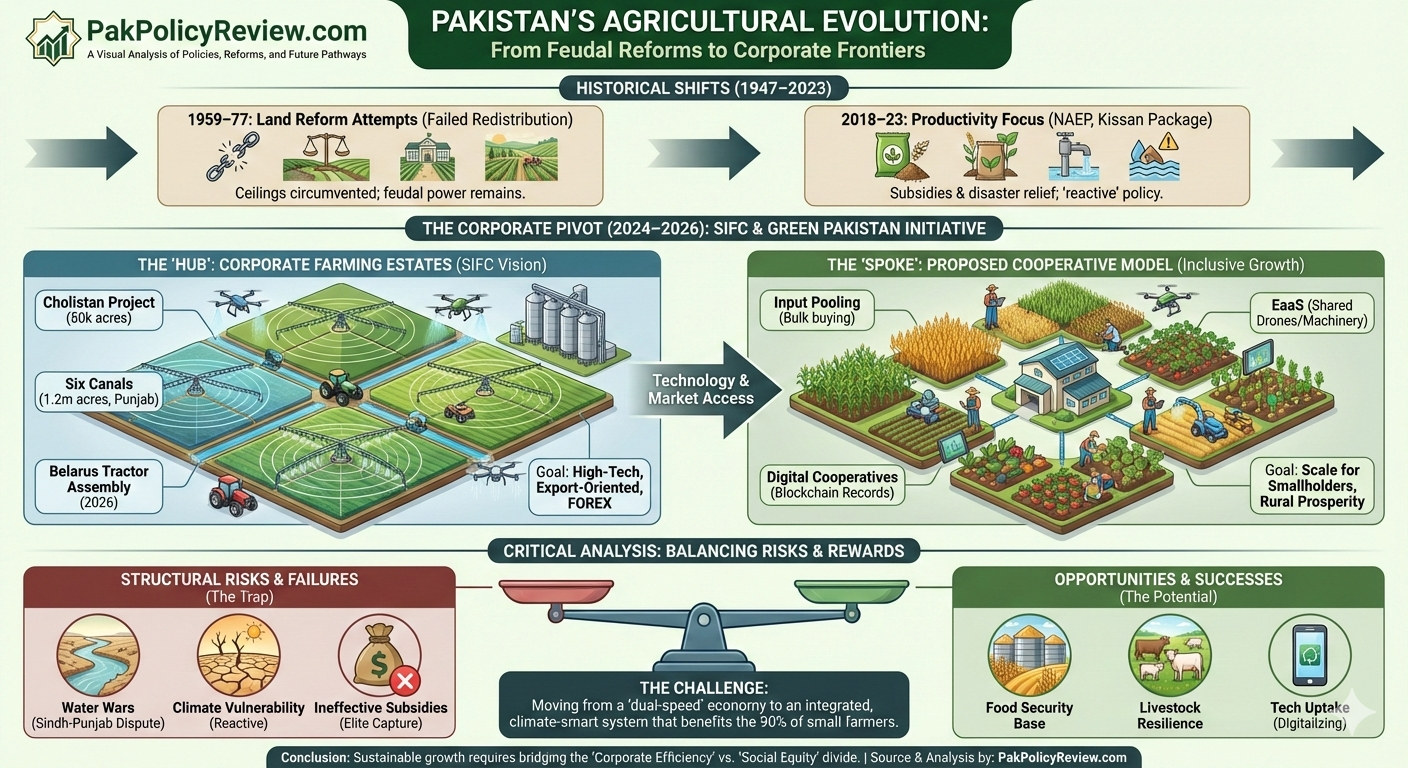
This was the first major attempt to limit landholdings.2 The ceiling was set at 500 acres for irrigated land and 1,000 acres for un-irrigated land.3
- Outcome: The reforms were largely circumvented. Landlords transferred holdings to family members or used “Produce Index Units” (PIUs) to exploit legal loopholes. Only a small fraction of land was actually redistributed.
- The Green Revolution: Concurrently, the 1960s saw the introduction of High-Yielding Varieties (HYV) of wheat and rice, alongside massive investments in tube wells and fertilizers.4 This led to a “food self-sufficiency” milestone but widened the gap between rich and poor farmers.
The 1972 & 1977 Reforms (Z.A. Bhutto Era)
Bhutto’s government took a more populist approach, slashing ceilings to 150 acres (irrigated) and 300 acres (un-irrigated).5
The 1977 Act: Further reduced the ceiling to 100 acres (irrigated). However, these reforms were stalled by political instability and later partially struck down by the Shariat Appellate Bench of the Supreme Court in the 1980s, which ruled that compulsory land resumption was “un-Islamic.”
Key Shift: For the first time, land was resumed by the state without compensation and distributed for free to landless tenants.
2. Modern Policy Framework (2018–2026)
In recent years, the focus has shifted from redistributive land reforms to productivity-led growth and resource management.
The National Agriculture Emergency Program (NAEP)
Launched to combat stagnant yields, this multi-billion rupee initiative focuses on:
- Productivity Enhancement: Subsidies on certified seeds and machinery for wheat, rice, and sugarcane.7
- Water Conservation: Lining of watercourses and promoting “Per Drop More Crop” through drip and sprinkler irrigation.
- Livestock Development: Genetic improvement of breeds and foot-and-mouth disease (FMD) control.
The Kissan Package (2022–2025)
Triggered by the catastrophic 2022 floods and subsequent inflation, this package provided:
- Interest-free loans for small farmers in flood-affected areas.8
- Subsidized electricity for tube wells (Solarization initiatives).
- Reduced prices for DAP and Urea fertilizers.
Corporate Farming & the SIFC (2024–2026)
The establishment of the Special Investment Facilitation Council (SIFC) marks a paradigm shift. The government has allocated thousands of acres of “wasteland” for Corporate Social Responsibility (CSR) and large-scale commercial farming, inviting foreign investment (primarily from Gulf countries) to modernize the sector through mechanization.
3. Key Pillars of Current Reform
| Pillar | Focus Area | Impact/Goal |
| Water Management | Solarization of 100,000 tube wells. | Reducing reliance on expensive diesel/grid power. |
| Digitalization | E-Khad and Digital Girdawari (Land Records). | Direct subsidy transfers to eliminate “middlemen” (Arthis). |
| Seed Sector | Amendment to Seed Act 2015. | Encouraging private R&D for climate-resilient varieties. |
| Livestock | Export-oriented meat and dairy processing. | Diversifying from traditional crop-based exports. |
4. Critical Analysis: Successes & Persistent Failures
The Successes
- Food Security Stability: Despite climate shocks, Pakistan has remained a top producer of wheat, rice, and sugarcane, often maintaining a surplus for export.
- Livestock Resilience: The livestock sector has consistently outpaced the crop sector, providing a vital “safety net” for rural households.
- Technological Uptake: The recent push for drone-based spraying and satellite-based crop monitoring (notably in Punjab) is beginning to bridge the productivity gap.9
The Failures (The “Structural Trap”)
- Ineffective Subsidies: Most subsidies (fertilizer and electricity) are captured by large landowners. A 2024 PIDE study revealed that billions spent on fertilizer subsidies often fail to lower the final market price for smallholders.
- The “Water Crisis”: Pakistan has the world’s largest contiguous irrigation system, yet it faces 38% water loss due to seepage and theft.10 “Abiana” (water tax) is too low to cover maintenance, leading to infrastructure decay.
- Climate Vulnerability: Agriculture is on the front lines of climate change.11 The 2022 floods caused $12.9 billion in damages to the sector. Current policies are reactive rather than proactive in building long-term climate resilience.
- Feudal Persistence: While formal land reforms are “dead,” the political influence of large landowning families prevents the implementation of an Agricultural Income Tax, placing the tax burden on the industrial and salaried sectors.
- Market Inefficiency: The “Middleman” (Arthi) system remains the primary source of credit and market access for 80% of farmers, often leading to debt traps and exploitative pricing.
Conclusion
Pakistan’s agricultural policy is currently in a state of transition. While the move toward Corporate Farming under SIFC promises high-tech modernization and foreign exchange, it risks further marginalizing small-scale farmers if not balanced with inclusive rural development. The true test of these reforms will be whether they can transform the “low-yield, high-input” model into a “climate-smart, export-led” industry that benefits the actual tiller of the soil.