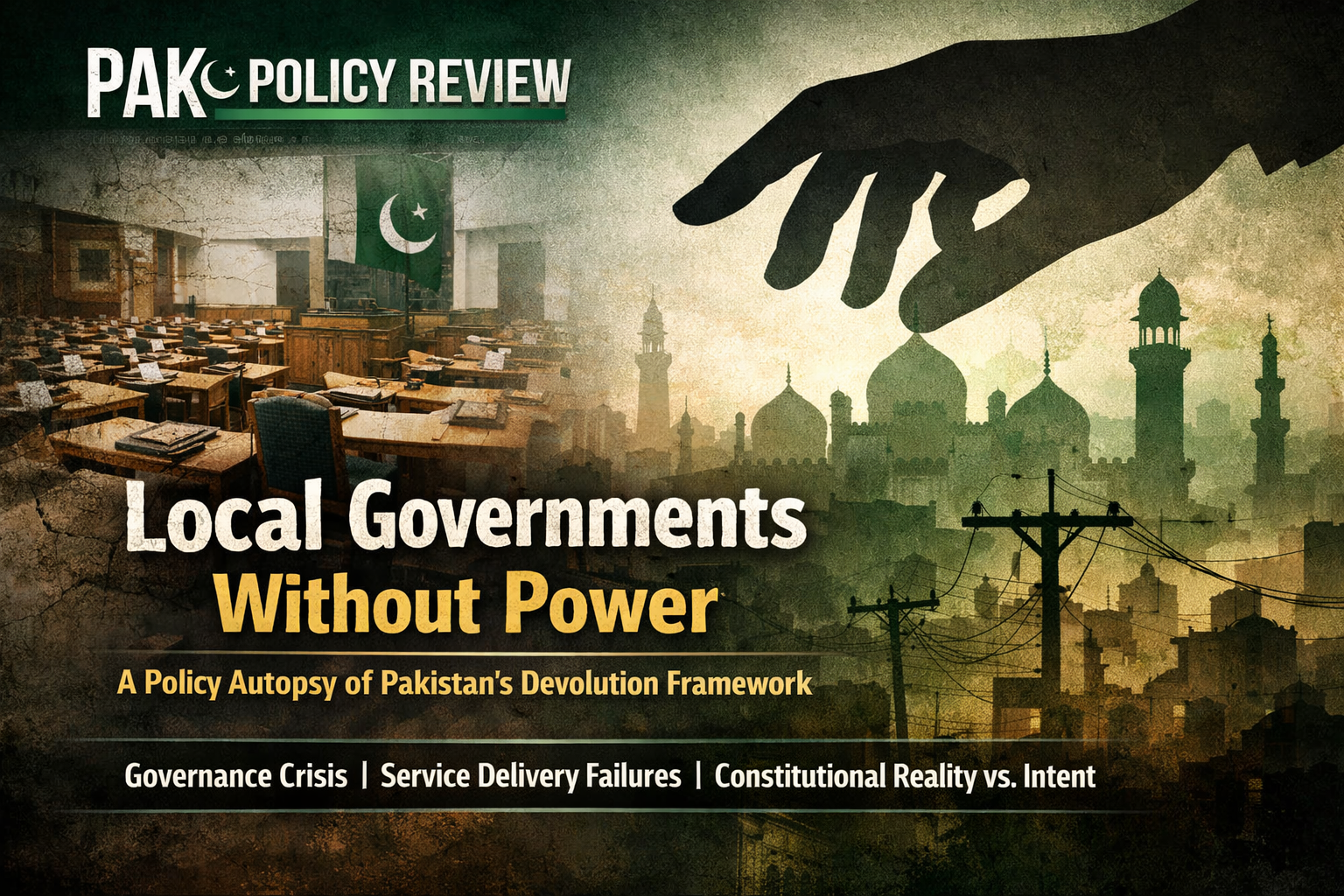
Pakistan’s repeated experiments with devolution have produced a paradoxical outcome: local governments exist, yet they remain largely powerless. Despite constitutional promises and frequent political declarations in favour of grassroots democracy, the country’s local governance framework has failed to translate authority into practice. What survives is a skeletal structure of elected councils and administrative tiers that lack the financial, political, and administrative autonomy necessary to function as meaningful engines of service delivery and accountability.
The constitutional intent behind devolution, particularly following the 18th Amendment, was to push governance closer to citizens by decentralising authority and enhancing democratic participation. Local governments were envisioned as the frontline of the state, responsible for municipal services, local planning, and community development. In theory, this framework aimed to correct the historical over-centralisation of power by empowering elected representatives at the grassroots. In reality, however, provinces emerged as the new centres of centralisation, absorbing authority rather than sharing it. The absence of enforceable constitutional guarantees for local governments allowed provincial administrations to retain discretion over the scope, timing, and depth of devolution.
This disconnect between intent and implementation has severely undermined governance outcomes. Local governments in Pakistan operate under constant uncertainty, frequently dissolved, restructured, or placed under unelected administrators. Delays in local elections have become routine, often justified under legal or administrative pretexts that mask deeper political motivations. As a result, local councils rarely enjoy continuity, depriving them of the institutional memory and stability required for long-term planning and policy execution.
Service delivery has been the most visible casualty of this hollowed-out devolution. Municipal services such as waste management, water supply, sanitation, and local infrastructure suffer not because of an absence of need or demand, but due to a lack of authority and resources at the local level. Most local governments remain financially dependent on provincial transfers that are unpredictable, conditional, and insufficient. Without the power to levy meaningful local taxes or control development budgets, local representatives are reduced to intermediaries rather than decision-makers. Citizens, in turn, face chronic service failures while lacking clear avenues for redress or accountability.
The administrative architecture further compounds these problems. Overlapping jurisdictions, parallel authorities, and provincial line departments routinely encroach upon local mandates. Urban planning, land regulation, and infrastructure development are often controlled by provincial agencies that operate with limited local consultation. This fragmentation not only weakens accountability but also distorts policy priorities, as decisions are made far from the communities they affect. Local governments are left to manage public expectations without possessing the tools to meet them.
The persistence of weak local governance is not accidental; it reflects a deeper political economy of control. Provincial elites and bureaucracies have little incentive to devolve real power, as doing so would dilute their authority and disrupt patronage networks. Empowered local governments would introduce new centres of political legitimacy, potentially challenging established hierarchies. Consequently, devolution is treated as a reversible administrative arrangement rather than a permanent democratic principle.
This resistance has broader implications for Pakistan’s democratic health. When citizens are disconnected from decision-making at the local level, politics becomes abstract and transactional. Voters are encouraged to seek solutions from provincial or federal representatives for issues that are inherently municipal, reinforcing a cycle of centralised dependency. Over time, this erodes public trust in democratic institutions and normalises governance by distant, unaccountable actors.
For devolution to move beyond symbolism, local governments must be recognised as a genuine tier of the state, with protected tenure, fiscal autonomy, and administrative authority. This requires more than legislative tweaks; it demands political commitment to share power rather than merely redistribute responsibilities. Without predictable financing, independent planning authority, and protection from arbitrary dissolution, local governments will remain structurally incapable of delivering results.
Pakistan’s governance challenges — from rapid urbanisation to service delivery deficits and social fragmentation — cannot be resolved through centralised decision-making alone. Strong local governments are not a threat to provincial authority; they are a prerequisite for effective governance and democratic consolidation. Until the gap between constitutional promise and political practice is addressed, devolution in Pakistan will remain a policy aspiration rather than a lived reality, and citizens will continue to bear the cost of a system that governs them without truly empowering their communities.