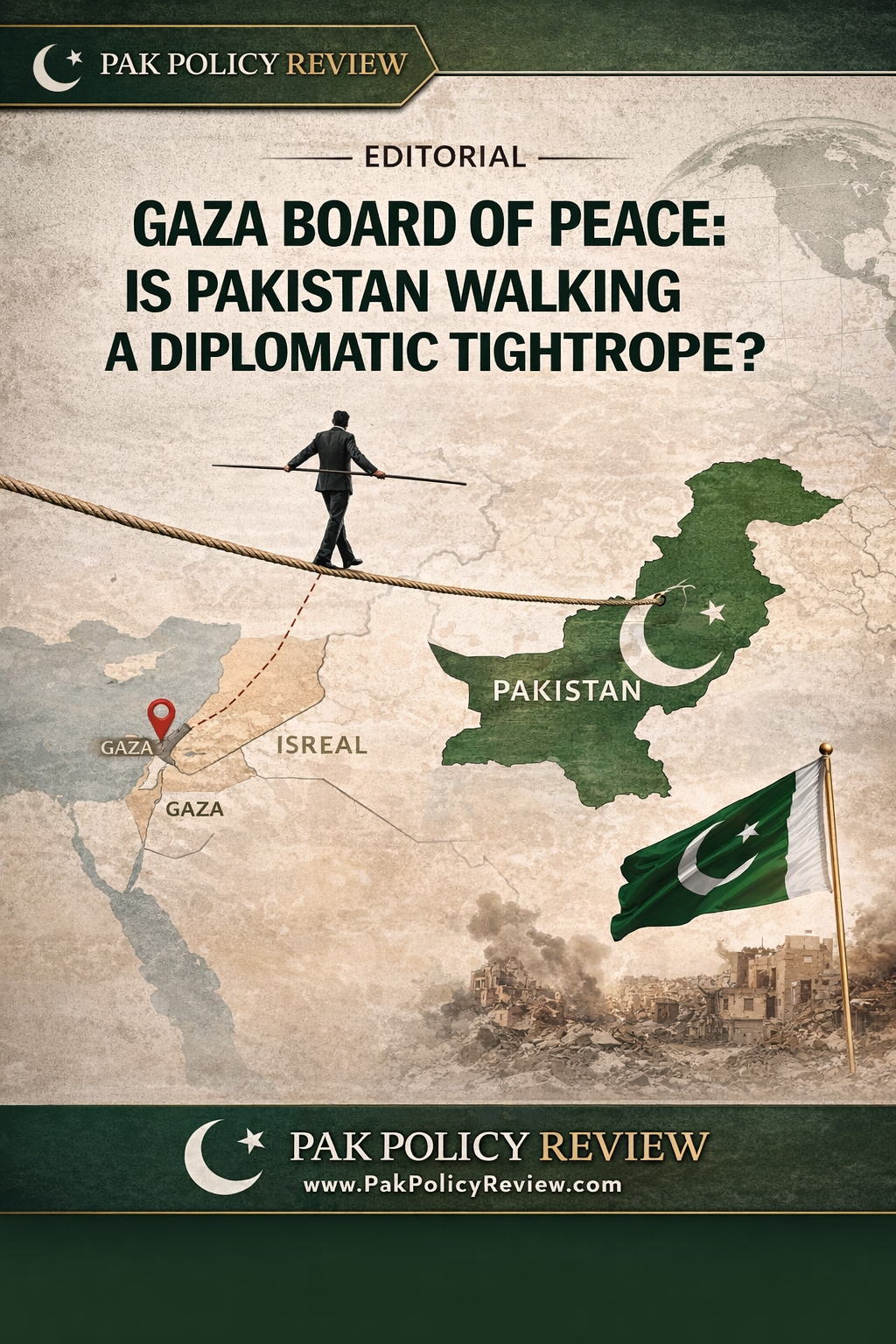
Pakistan’s reported decision to join a proposed Gaza Board of Peace, following an invitation linked to former U.S. President Donald Trump, places Islamabad at a delicate crossroads of morality, diplomacy, and realpolitik. At a time when Gaza remains a symbol of humanitarian catastrophe and international paralysis, Pakistan’s move—if confirmed—demands careful scrutiny rather than celebratory headlines.
For decades, Pakistan has anchored its Palestine policy in principle over expediency: support for Palestinian self-determination, rejection of occupation, and insistence on solutions grounded in international law. Any departure from this trajectory, even if tactical, risks eroding long-held credibility in the Muslim world and among Global South states.
From one perspective, participation in a peace-oriented forum could be interpreted as constructive engagement. Pakistan, a country with a consistent record of UN peacekeeping and diplomatic advocacy for oppressed populations, may see this as an opportunity to inject balance into an otherwise skewed discourse. If Islamabad uses the platform to push for ceasefires, humanitarian access, and civilian protection, it could reinforce its image as a responsible middle power willing to speak for the voiceless.
Yet the risks are profound.
Peace initiatives associated with unilateral U.S. frameworks—particularly those lacking UN endorsement or Palestinian consensus—carry the stigma of managed conflict rather than just peace. If the Gaza Board of Peace is perceived as another externally driven mechanism designed to stabilize the status quo rather than end occupation, Pakistan’s participation could be read as tacit endorsement of an unequal order.
Regionally, the move complicates Pakistan’s already complex balancing act. Relations with Iran, growing ties with China, and traditional solidarity with Arab and Palestinian causes all sit uneasily alongside visible alignment with a U.S.-backed initiative. In an era of sharpening geopolitical blocs, even symbolic gestures are closely scrutinized.
Domestically, the political calculus is no less sensitive. Pakistani public opinion remains overwhelmingly pro-Palestinian and deeply distrustful of American-led “peace processes.” Any perception that Islamabad is diluting its stance—intentionally or otherwise—could provoke public backlash and political controversy.
Ultimately, the question is not whether Pakistan should engage in peace diplomacy, but on whose terms and to what end.
If Pakistan’s role is meaningful, principled, and anchored in clear red lines—support for a two-state solution, rejection of forced displacement, and insistence on UN legitimacy—then engagement may serve both moral and strategic ends. If, however, participation is merely symbolic, offering legitimacy without leverage, the cost to Pakistan’s diplomatic capital may far outweigh any short-term gains.
Peace in Gaza cannot be choreographed through boards and communiqués alone. It requires justice, accountability, and political will. Pakistan must ensure that in seeking a seat at the table, it does not become part of the furniture.